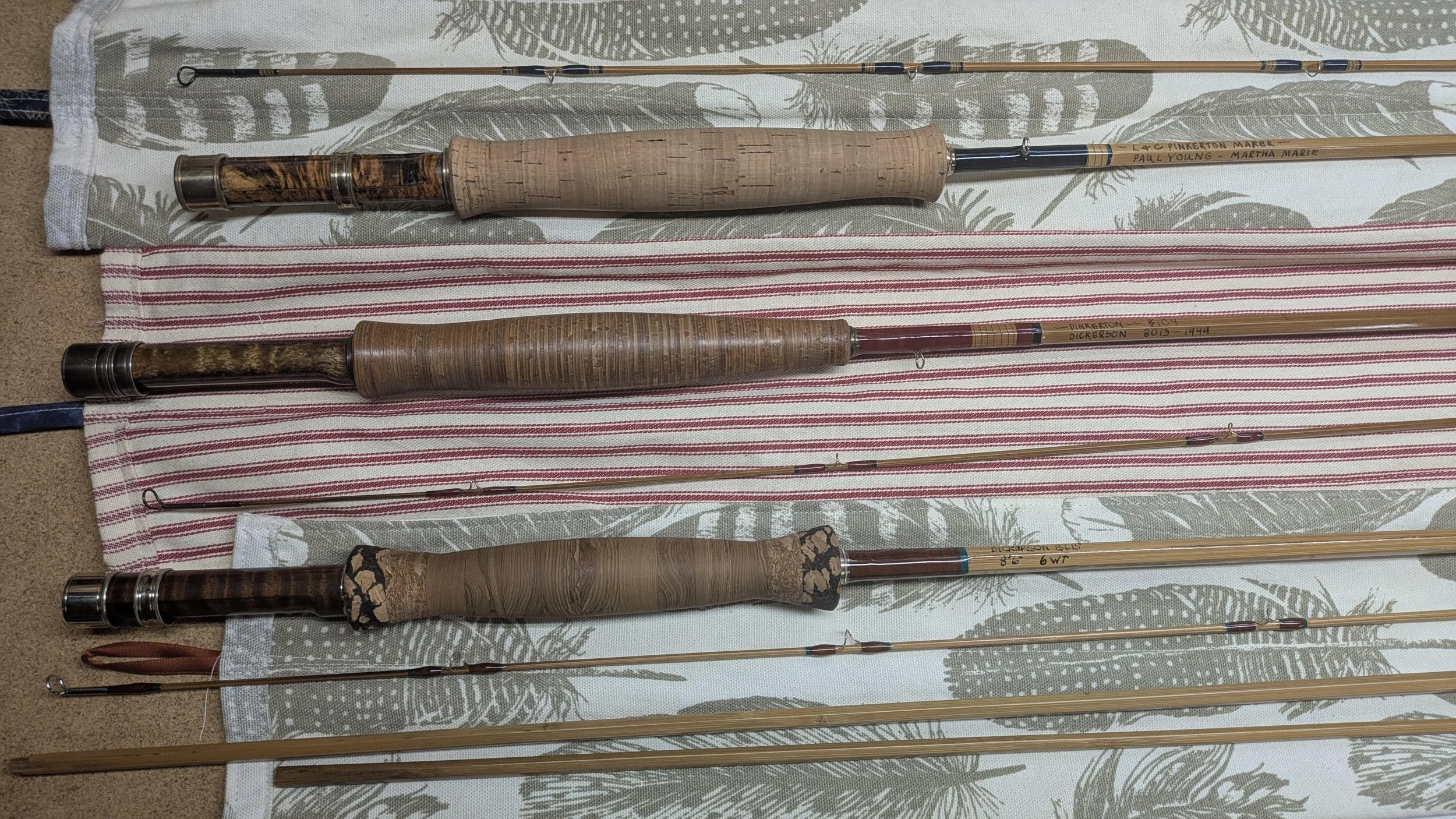
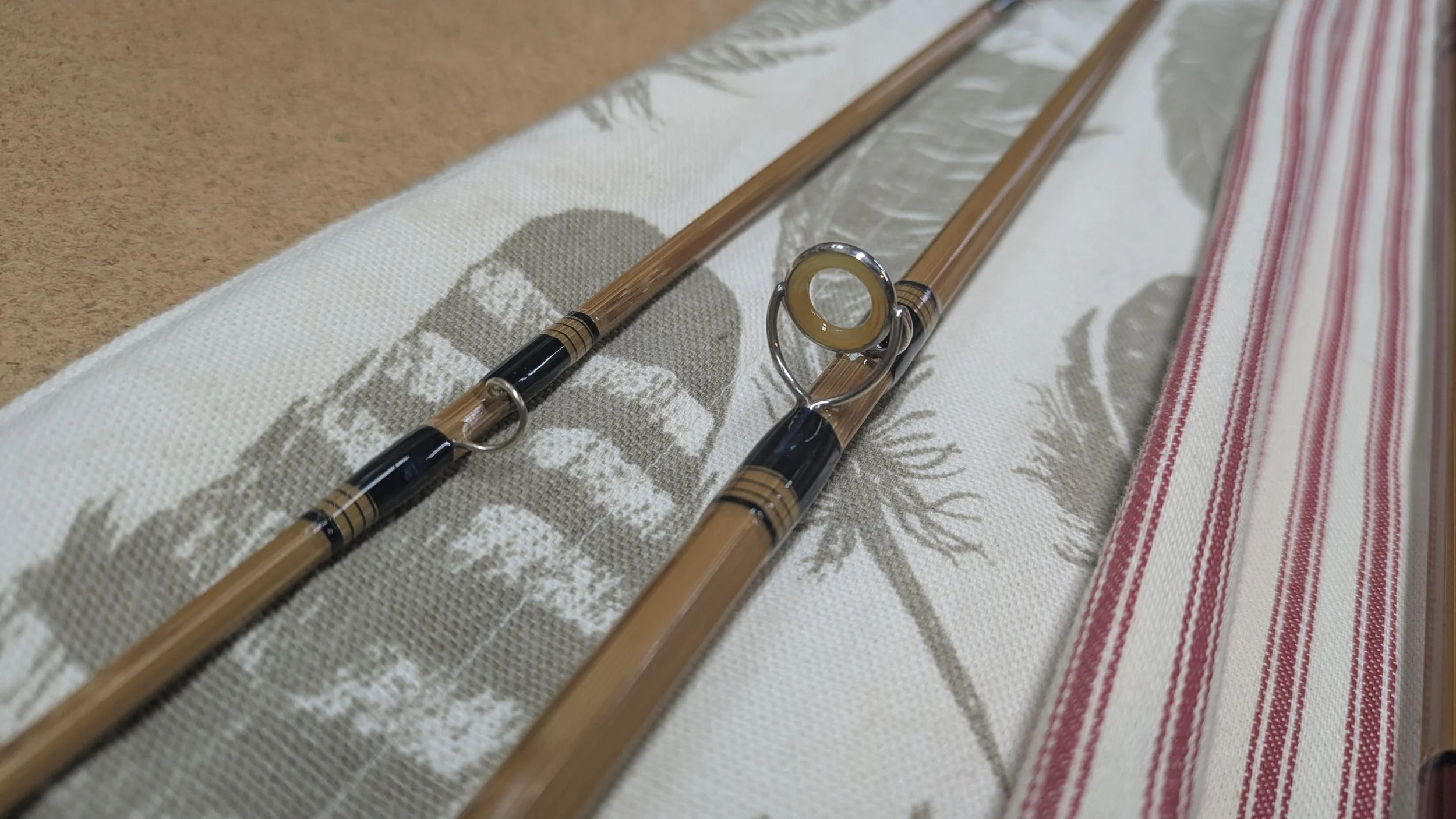
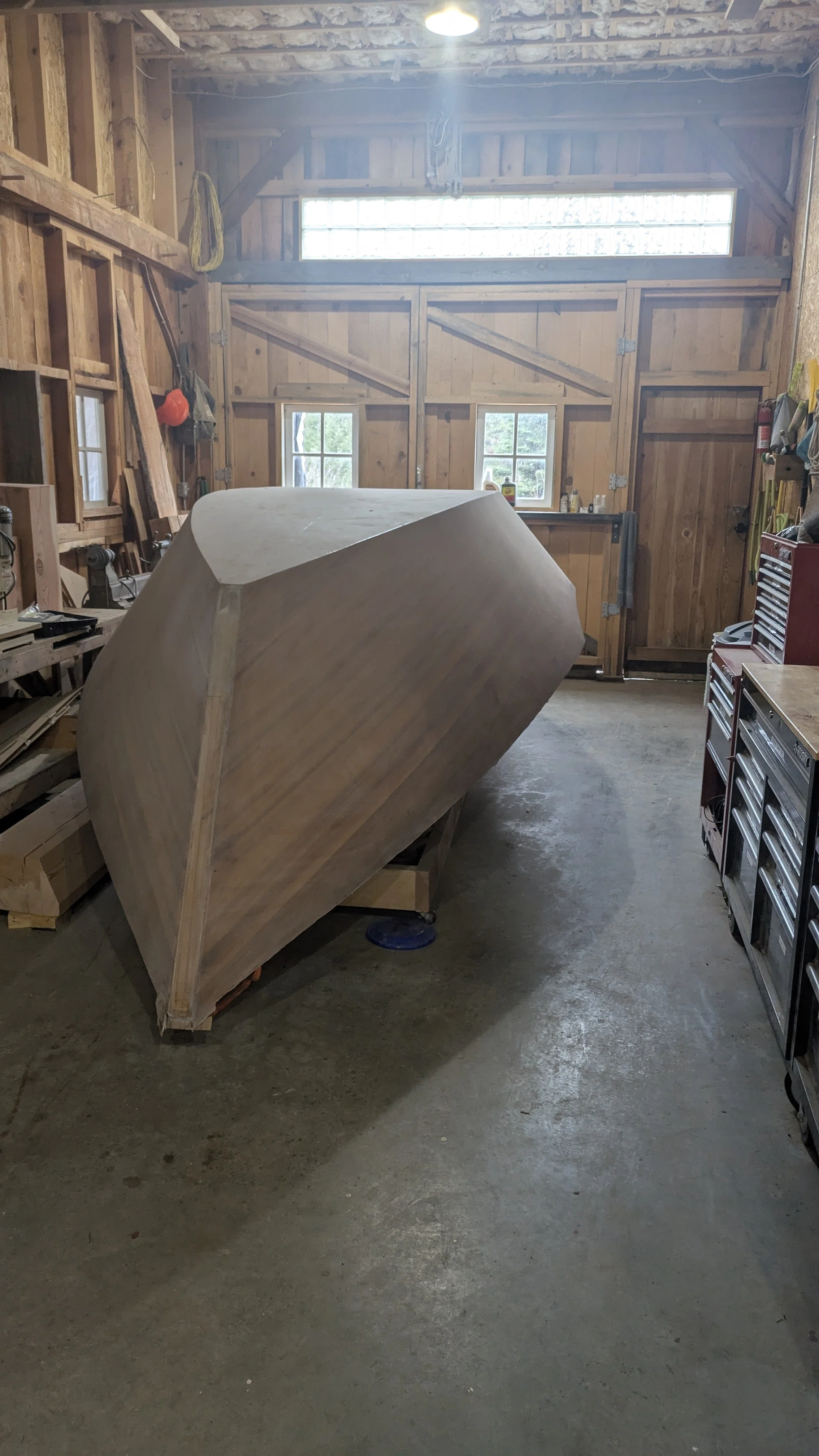
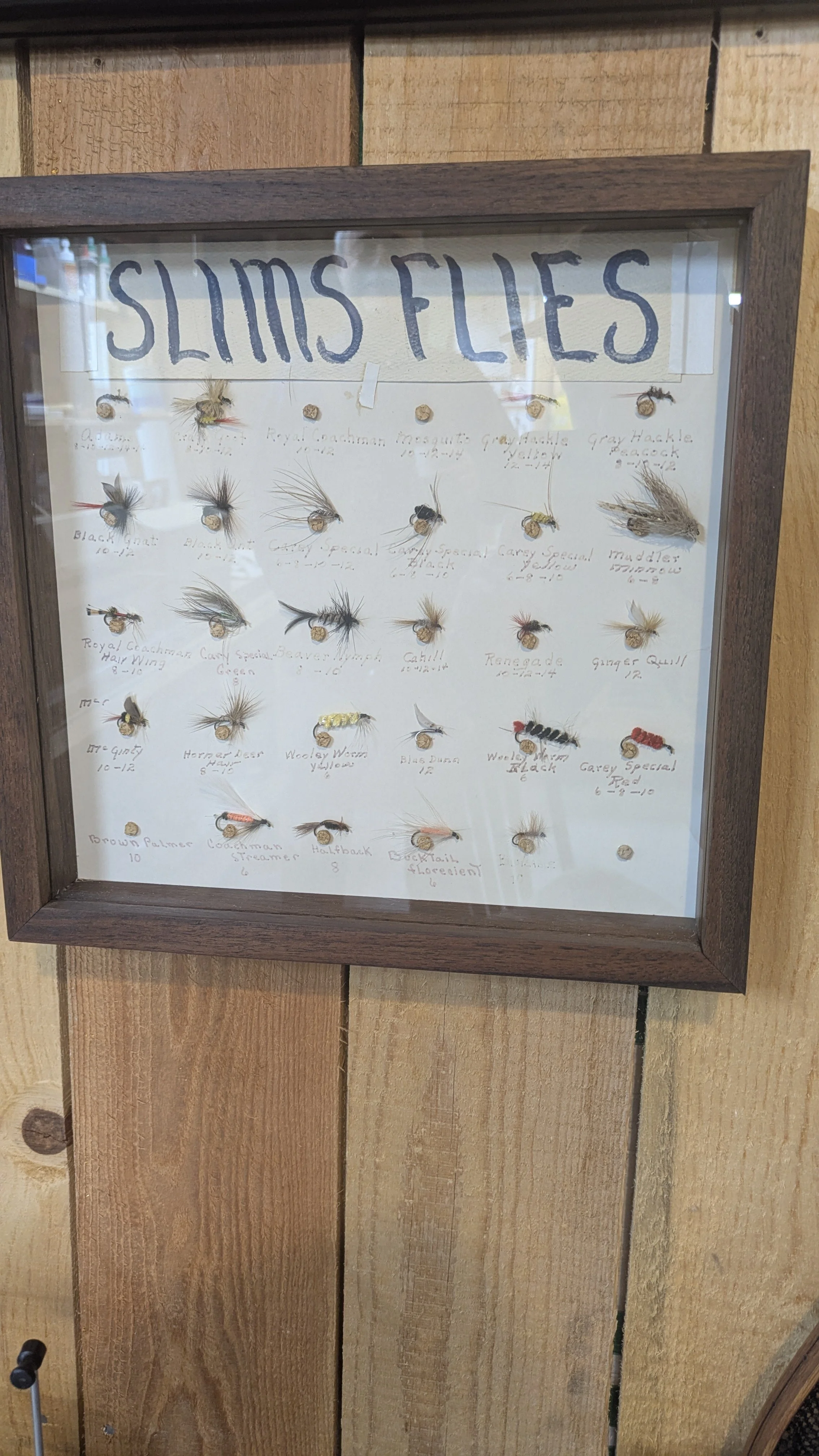
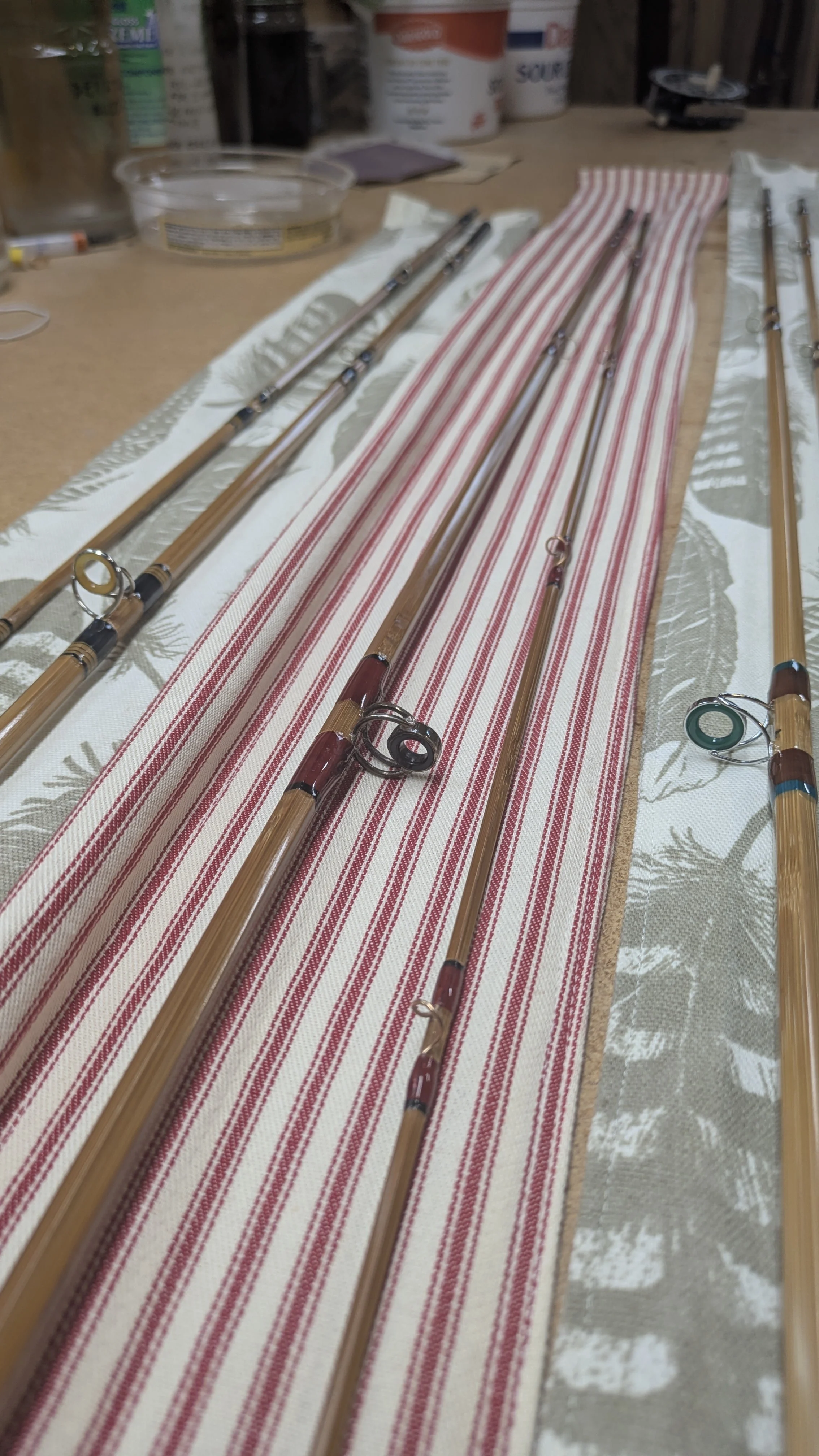
This past week I had the opportunity to have a conversation with–and somewhat interview– a local bamboo fly rod builder named Lester Pinkerton. You may know him as a commissioner here in Boundary County, but let me tell you right now that you should meet with Les Pinkerton, the master craftsman. From the house to the drift boat to fine bamboo rods and even the shadowboxes of displayed flies, the whole building that I toured around was like walking into an art gallery. And the man himself was a pleasure to meet as well.
The following is a good bit of the transcribed interview. About thirty minutes into our conversation, I realized that I should have been recording from the time that I stepped through his door and was greeted by his wonderful dog, Otto. The place was warming, and Les was as inviting as ever as we immediately launched into a conversation about a seventeen foot cedar drift boat that he and his son are currently building. After running back to my car to grab the coffee cup I forgot, we soon ascended up the stairs to where the magic happens: Les’ workshop. The air was heavy with the smell of burning wood, peeled wood, soaps, glues, and everything else you could ever want to smell in a little slice of heaven. We walked through an area where one of his sons works on leather goods, past the table where his wife Karen has a small soap operation, and then we were among the planing form, hand planes, the shaved bamboo, all the bits and bobs needed to masterfully craft not only a fishing rod but a pure piece of artwork.
Trust me, his rods are all beautiful pieces of art. And I am not just saying that in hopes that he will put aside some time to work with me and build me the creek rod of my dreams.
—-----------------------------------------------------------------------------------------------------------------------------
James(J): To start, would you just introduce yourself. Who are you, what do you do?
Les Pinkerton (LP): Les Pinkerton. I grew up in Bonners Ferry. I was actually born in Bonners Ferry. And then my career took me all over the country. As I went through 30 some years, you know, with the forest service from coast to coast, you know, Alaska to Arkansas. So we traveled quite a bit, and then, you know, 10 years or so ago, I was retired and had the option to come home. Growing up in a rural community with both sides of my family here, you learn to do a lot of different things at a very early age. My brothers and I, we all left in our early 20s. We were at a point that we were thinking “dad’s trying to work us to death”. But with that, by the time we were in our 20s, we were well worked and you end up picking up a lot of different crafts and abilities: mechanical, carpentry, logging, whatever you know.
Anyway, back to the fly rods. I always love going back to my grandfather when he would take me fishing at an early age. I was always his sidekick because I’m the oldest in my generation. The first one to come up, you know? I was always off with Grandpa Norris. And I still have his rods [Les points up to one of his storage racks on the ceiling where two old fly rod tubes are resting] He was into the old Fenwicks. That was the top of the rods in that day, the late 60’s, early 70’s. And then traditionally, the option came up when one of my sons, Chris, said to look at bamboo fly rods. I’m thinking, can I actually even do it?
I bought all the books I could get my hands on, read everything, and then of course, working through YouTube nowadays too if you got any extra questions. Through this, you end up with the fundamentals and with having good skills from working in my early life, I was able to work my way right into generating some beautiful rods and a wonderful craft.
J: Hey, I mean, what’s better than just going, “I want this fly rod. Well, let me make a blank of it and I can just make the whole thing myself”?
LP: Pick one out of the many options from the old masters and say, yeah, okay, let’s try that one. It’s a beautiful option. It’s a wonderful craft.
J: Oh yeah. Go online and try to find an old Wes Jordan Orvis rod measurement. Just get the dimensions and build it yourself. Can’t complain about that. So, anyway, you came back here, retired, and got into local government. [Laughs]
LP: Yeah, you know there are a lot of things in my career that just happened by accident, and this is one of them.
J: Before we had started here, we had been talking about how you got started in the building of bamboo fly rods. You know, why did you choose bamboo over just rolling graphite or fiberglass blanks.
LP: The fundamentals.
J: Yeah.
LP: As you can see in this building itself, I love woodwork. I love woodwork and I love the craft, the potential of it all. I was telling you about Slim Allured’s sports shop in town. I did a little bit then. Slim was rolling out a fiberglass blank one day, but it was nothing like this. This [Les points towards three laid out bamboo rods that he built for himself and his sons] this is artwork when you get done with it. From blank culms of bamboo, that’s what I start from, to splitting chunks off of that and milling it down.
J: Well, it is a little different than just buying a blank and just tying components on [laughs].
LP: Yeah, I would definitely agree with that. But it’s also something fundamental for me, you know, going from blank culms that come in a real rough setting to that final product. Just generating something so unique and so beautiful, really.
J: Yeah, honestly, I could stare at those for hours.
LP: Yeah, I have achieved something there.
J: Yeah, and something that will hypothetically last forever too.
LP: [Laughs] So several that I’ve made, and some that I remodeled and rebuilt too, I would ask them, “alright, are you going to fish it…or are these going on the wall?”
I’m building them to fish because there is something about being in a drift boat, floating the river and working a fly rod that was built for you.
J: That actually brings up an interesting question. I know there’s a lot of people who just collect. You know, spend the money to collect expensive bamboo fly rods and just put them on the wall. And in my opinion, after an artist has put that much time into something, they expect it to be fished. So, how does that make you feel, you know, if someone had you build a rod for them only to hang it up for display?
LP: I’m okay with it if that’s what they want to do as an individual.
J: That’s fair enough.
LP: But, take it out and fish it. That’s what's on the end of the line; where it all comes together. It’s something really neat that touches you deeply. All of a sudden I craft this, and I’m reeling in this fish off the end of it.
J: I will say that that brings up another one of the questions I had. I tie flies, and I remember the first time I caught a fish, a decent fish, not just some bluegill or something, on a fly that I tied myself. I still remember the moment, the day, the time. It was very important to me. But I can only think that building your own fly rod from the ground up and then catching your first fish on it would be an even better feeling.
LP: Yeah, yeah. And then, we’re working on the next step which is that drift boat downstairs. We are going to be fishing fly rods we built from a boat that we built, too.
J: Yeah, that’s a good point. Now you just got to start spinning your own fly line [laughs].
LP: I’ve actually looked into it.
J: Really?
LP: Oh yeah, there’s machines that you can buy that spins the old silk.
J: Do you run silk lines on your reels?
LP: No, no. I just run the plastic stuff. I’ve used some silk tips and I didn’t have any luck with them. I’m an okay fly fisherman [laughs], and now there is so much more to it than there was in the 70s. My career took me all over, I didn’t have much time for fishing. You know, time was really tight. I was in hibernation for years, and I was able to come back to really refocus back on the beginning. My other brother Lee retired, came home to the same thing. Back to the beginning, where we were building this kind of stuff and it’s kind of a beautiful thing. It’s neat to have the skills and experience and the health to be able to continue to do that.
It’s wonderful. We built this building. This little craft area. We got a lot of hours in it, and my kids now are into it. They got their stuff that they’re doing. We’re working that next generation, and we all tie it in. This is the way I want my rods to turn out. I love the creativity it opens up. We have some options. Let’s stand back, and let’s figure out how we can turn out a beautiful piece of art.
J: So, how many rods do you think you’ve built?
LP: In the 20s. 20 something.
J: And when you are done, do you usually, you know, test cast it?
LP: Yeah, maybe [laughs].
J: So the next question would be, what’s your favorite? Do you have a favorite taper?
LP: I do. And actually, it’s the one that I’m building right now. It’s the Paul Young Martha Marie. It’s been the best one.
J: A classic.
LP: I focus on trying to build for the river. I love to float. I love camping on the river. I love to have that resource. I’m kind of building all the rods to work the river. I built a rod for a friend over in Montana; another five weight I built. I forget the name of it, but it was just a little too light. The old masters, they were using old line too. So, the new lines on them add a different weight so you have to kind of mess with it.
J: You find the balance.
LP: Yeah, the right weight line, and that one I built for my friend was supposed to be a five weight, and it came out to fish a modern four weight line. Alright, so it’s too light for the river. I had another four weight I sold, and it went to Wyoming to a guy who was creek fishing. They loved it. I didn’t like it at all. You know, the four weight. When you get down to the end of the tips, so it’s fine, you know, I got the calipers out and measure it. You're smaller than a toothpick there.
J: I guess that’s probably why you don’t see many three weights and nothing below. No one’s making a zero weight bamboo rod.
LP: No, but I really just love the five weight.
J: I want to talk about lines a little bit. For me, any of my bamboo rods, it is double taper or bust. I can’t use anything else. Is it the same for you?
LP: Oh no, it’s just whatever makes the roll happen. Back in the 70s, we didn’t have much of that here. Again, I kind of had to relearn all that. I try to buy some decent lines that lay out straight and rolls nice. If it coils up, it goes in the garbage can.
J: I use a lot of old traditional reels. I don’t need, or necessarily enjoy, the fancy new stuff. The only modern reel I have is a new Orvis Battenkill that is a remake of an older click and pawl reel.
LP: I really use any tools. I don’t know where my reels are at, and I can’t even think of the name of it right now. I like the old though: traditional Hardys, you know. We have one of those. (My son) Chris picked it up, and it is a pre-war reel, you know? I don’t know if we will use it, or put it on the wall. I think I need to try something a little bit newer.
You talked about tying your first fly. I have that memory also, from the time we were living at Eastport and I was with a close friend of mine here in town. We were working and tying flies. I think we were in eighth grade. I can remember tying this bumblebee looking thing and I go, “come on, let’s go try it”. We headed out to the Moyie right there at Eastport. Oh man, I had a really nice trout hooked with it.
J: I have two first flies. When I was about seven years old, my dad bought me a fly tying kit. He wasn’t a fly fisher, but he fished with flies on a spinning rod with a bobber used just to get the fly out there. First thing I did was took a hook and just wrapped black thread around it, tied it off, and went, “here, dad, look at this”. He probably was thinking, “What the hell is this?” when he held it in his hand but we went out to Perkins the next day and with his first cast, he caught a decent rainbow trout on it. It made me go, “whoa, maybe I got something here”.
Then I sat down and actually put the VHS tape the tying kit came with on. The first fly pattern was a woolly bugger, and I just spent the whole summer only tying woolly buggers.
I tied some sparkle minnows and other streamers this winter so far and just went, “I am never going to tie streamers again”. [laughs]
LP: Yeah, there is quite a process to it. Slim was a fellow that used to tie the flies for the sports shop downtown. As an eighth grader or whatever, he grabbed me and said, “all right, I am gonna start showing you how to do it”. This is actually his old vise [Les points to an old metal vice on the wall next to a shadowbox of Slim’s Flies]. That was one of the old ones that he gave me and that I started on. So, I started kind of filling in for the sports shop tying flies. That’s his old display that I’ve kept [Les points at the shadowbox].
J: That is a great little piece of ephemera.
LP: Yeah, you can see that some of them have fallen apart. But oh, that’s that group of flies. You know, early 70s, maybe even the late 60s.
J: That is just a neat piece of Bonners Ferry history.
LP: Yeah, it really is neat.
J: And the shadowboxes?? You built those too?
LP: Yeah. Black walnut.
J: I love it.
LP: Yeah, it looks great. My next step is nets. That’s the next step. I got all the equipment to finally start rolling them out, but with that I’ll be damned by going back to work. That’s what’s messing up my fishing [laughs]. I was hoping I could get another one of my sons involved in that, but he didn’t bite. So, I got one building boats and I’m doing rods. I just need another one doing this.
J: I met a guy once down when I was living in Oregon on the Deschutes River. I’m talking to this guy who just got done fishing and he showed me a net. This was one of those guys decked out in everything expensive, but he could cast and he could catch. He wasn’t just some tourist. He had a landing net that he had custom made himself that had a little box cut out of the handle that had a fly that his late father had tied for him. I think that is a really beautiful idea.
LP: Man, that is…that’s a really neat idea.
J: Yeah, it was one of those things where I just sat there thinking, “that is cool. I might never have something like that, but that’s a really cool idea”.
LP: Well, if I get back to nets, we’ll talk.
J: Well, I got to ask. How can I convince you one day to build a rod for me? [laughs]
LP: Yeah, we’ll keep talking.
J: If it ever does happen, if I could ever be a part of the process of it. I would love to. I’ve always been so curious. I don’t have super fine hand and motor skills, but it’s something I have always been interested in. I got the bamboo bug for fishing about five years ago. I put graphite away for the most part and went to fiberglass. I wanted slower and I ended up with love for bamboo.
LP: You get that bug in your head in that direction. It’s just something more humbling. Maybe it’s like, you know, grounding and bringing it back to the basics. Basically the beginning. So that’s it right there.
J: When I’m standing in a creek and casting. There was a part of me that goes, yeah, I’m fishing but then there is just the other connection. It’s a hard thing to explain. There is such a difference in they way that it makes me feel. A lot of the people that fish bamboo I know feel the same.
LP: I know what you’re talking about. Have you floated the Kootenai?
J: Not for about 20 years. That’s kind of sad, but it’s been a long time since I have.
LP: One thing that I want is if there are any options for the commissioners to approve or improve access to the river, you know? We’re looking at angles, you know. We’ve been talking. There’s chunks of BLM ground going down through there. We recently were speaking with the Bureau of Land Management about enhancing a campground that was up from town and we couldn’t figure out how to make it work. There’s money out there. And we haven’t been able to put all the pieces together. Right now, you know you either put in at the Yaak or you put in at Twin Rivers. I really like putting in at the Yaak, but then of course you have the Montana section, which is really nice but that to the Leonia bridge. The river turns, and a lot of times when the river is low, it’s the roughest spot in the river. The Boulder Creek area. Down from there is a nice island, and you could pull your boats up. The public is using that area a lot.
J: I am going to have to do that. Up near Leonia is one of the only spots on the Idaho side of the Kootenai that you wade fish in really.
LP: Yeah, that next mile of river is one of my favorite sections, man.
Continued after a bit of rambling and talking about fishing spots…
LP: You know, the step of building fine bamboo rods, the one that I dislike the most is putting the ferrules on it. They don't fit together that well, so you put it on the lathe and you start working it. You got to get to the pop. You pull them apart and get the pop. you can go from that to a clunk, clunk, clunk though. I’ve ruined some. It’s just like I’ve had to cut the rod off, the end off of it, because of course the ferrules are glued on. I was looking at ferrules because I do like the nicer ones. They come already fitted, and I thought that would be a bonus. Then I would just have to fit them to the rod. [Les pulls out a package of new ferrules] Nickel silver. You gotta put a little work into it.
J: All these rods laid out that you built are two-piece rods. Are you only a two-piece guy, or have you ever made three-piece, four-piece rods?
LP: I do two because ferrules are such a pain in the butt [laughs].
J: Do you mind if I take a few photos?
LP: No, not at all.
J: [looking closer at the rods] Oh my god.
This was a slimmed down transcript of an hour and a half conversation I had in Les’ workshop. Much thanks to him for hosting me and showing me his fly rods, his home, his boat, his artwork. I hope one day to be invited back to point at a taper in his book of classic fly rods.
Tight lines out there, friends.