It was a warm spring day outside while I sat early in the morning inside Les Schwab trying my hardest to completely annihilate their freshly brewed pot of light brown water. New brake pads and rotors were being installed and I had been given a rough estimate of three hours that I would be sitting on my butt, reading a book and drinking from a styrofoam cup. A three hour estimate at a shop, in my past experience, usually means two and some change. Whether that is a mechanism of the mechanic to tout his “Job Well Done” by finishing it sooner than he said, or if they tend to be that quick in general, I will never know. But in the passenger side of my elevated vehicle in the brake shop was a 3wt Orvis Superfine that I was hoping to get into some water if I was able to buy a little time. The sooner I got out of this phone-ringing-off-the-hook hellhole, the more likely my wife would believe me when I told her “the car took a little longer than expected”. I checked my watch and it read that it had been two hours and some change when the lady called my name and I was on my way to the hills.
Now, I am a creek man. I like to spend my time among the smaller trout where 10” is a large fish, and anything a foot plus is a monster. It’s early May: the rivers and creeks are blown out, the lakes have melted but still a bit chilly for the topwater, and I am lost in a limbo of what to do and where to go.
I drove (without fear of my brakes failing for the first time in a week) along the Selkirks where I observed my favorite creeks, pure white rolling forces where the fish hold on for dear life and the fisherman watches a single slower run for ten minutes before shaking his head and decided it isn’t worth it. Though the mountains may have not had as much snow as they should have, the blow out will still be extreme for a bit. I considered driving up and taking a walk closer to their sources, but I just didn’t have the time (or a good enough excuse) for that to be an option at this time.
But then it hit me. There was a creek I knew of, one with the source close enough that the drive out would be possible and, as the ice had melted off of it more than a month ago, the flow of the creek should be pretty fishy by this time. I really had no idea what could be in there: maybe the abundant panfish made their way into this end of the creek with a bass or two enjoying the freedom with them. It is a creek that I know holds rainbow trout further down, but I had never been this far up it. But if there was a chance that a trout could find my dry fly, and this was the only creek not blown out, I will take that chance.
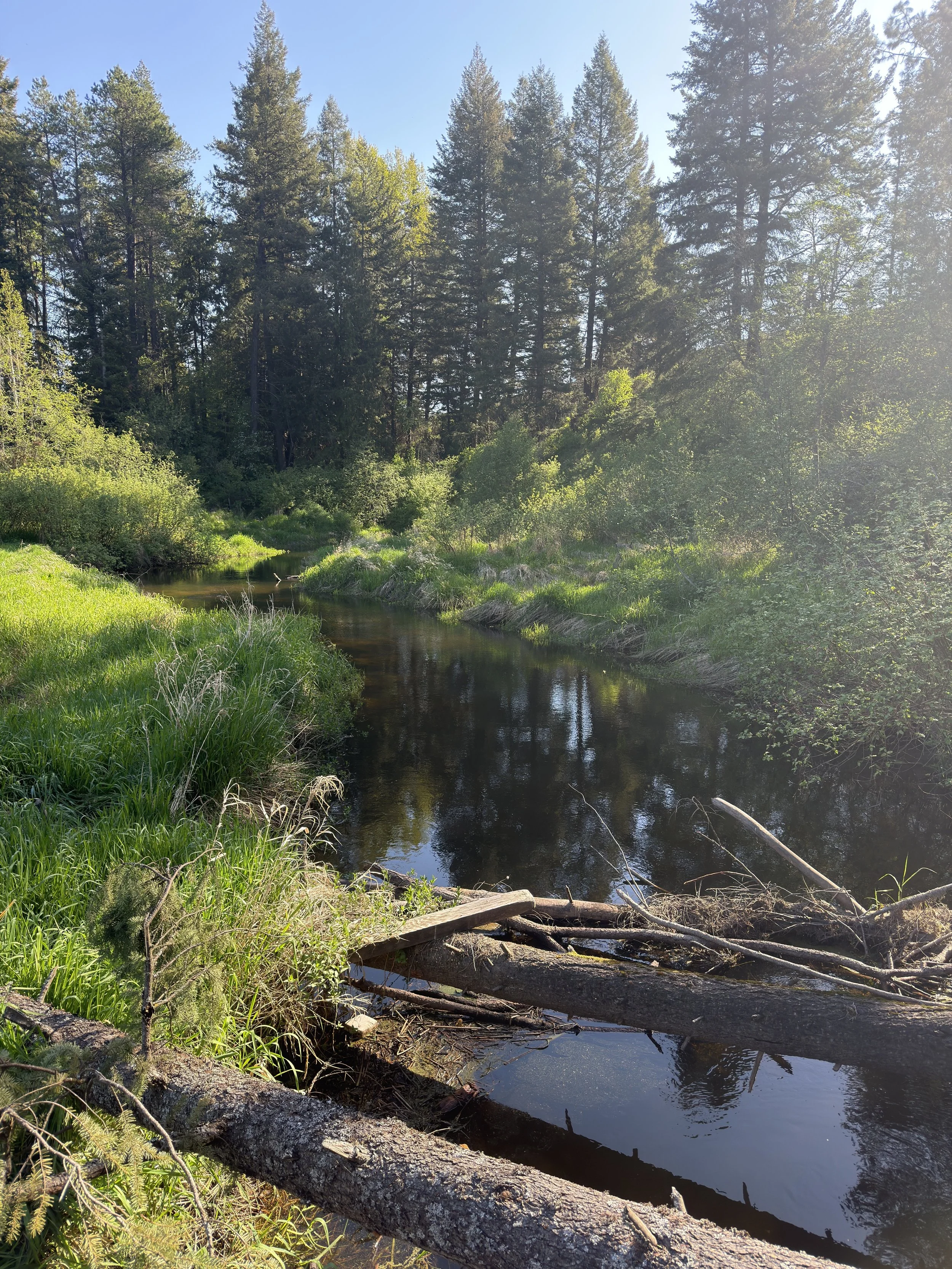
I parked in the small lot and rigged my fly rod up, grabbed my net and made my way down the trail, hoping to see something I deemed decent enough to take a few casts on. When I turned the final bend, what I came across looked like heaven. An unexpected mayfly hatch had recently started.
Baetis tricaudatus. The Blue Wing Olive.
Something was rising under the high shelf above the calm, lightly brown water (like I was back into that styrofoam cup from earlier). The shadows of the overhanging western redcedar and the doug pine cast shadows that danced ever so slightly on the water as the mayflies hovered until one or two hit the water, and the fish followed it up with a healthy slurp. I traded out the #14 renegade I had tied on earlier when I wasn’t expecting much with a #16 Adams, pulled a few yards of my line out and cast it upstream from where the last riseform was still expanding. I mended my line twice and let it drift to where the fish had been. A dark shadow rose and took it, making its way back down as I set the hook. Nothing too big, but it played a bit before it spat the hook and I lost it. But I had gained a very important bit of knowledge.
There was trout here, and the trout were hungry.
I watched as the mayflies shimmered in the early afternoon sun and waited to see another rise. When one didn’t come for a few minutes, all I could think about was my backpack back home that had my stove and my coffee pot in it. The creek called for it; it was as if I was at a picturesque pompous British stream when fly fishing was invented by tweed-laden men, puffing on pipes and saying “right-o” when a fish was found in their net. The lighting was such as I don’t even know if the world’s most powerful camera could capture what I was seeing; a windfall light of crepuscular rays, the komorebi, as a child fresh from sunday mass would call “God’s fingers” painted the landscape in a way that was not as much religious was it was puzzling. Shadows in which from what they were cast seemed non-existent. Moss amongst the reeds where I rested. A Mountain Bluebird from one side, the Red-winged Blackbird from the other, the chook-chook-chook of a Stellar’s Jay from somewhere above. A splash in the creek below.
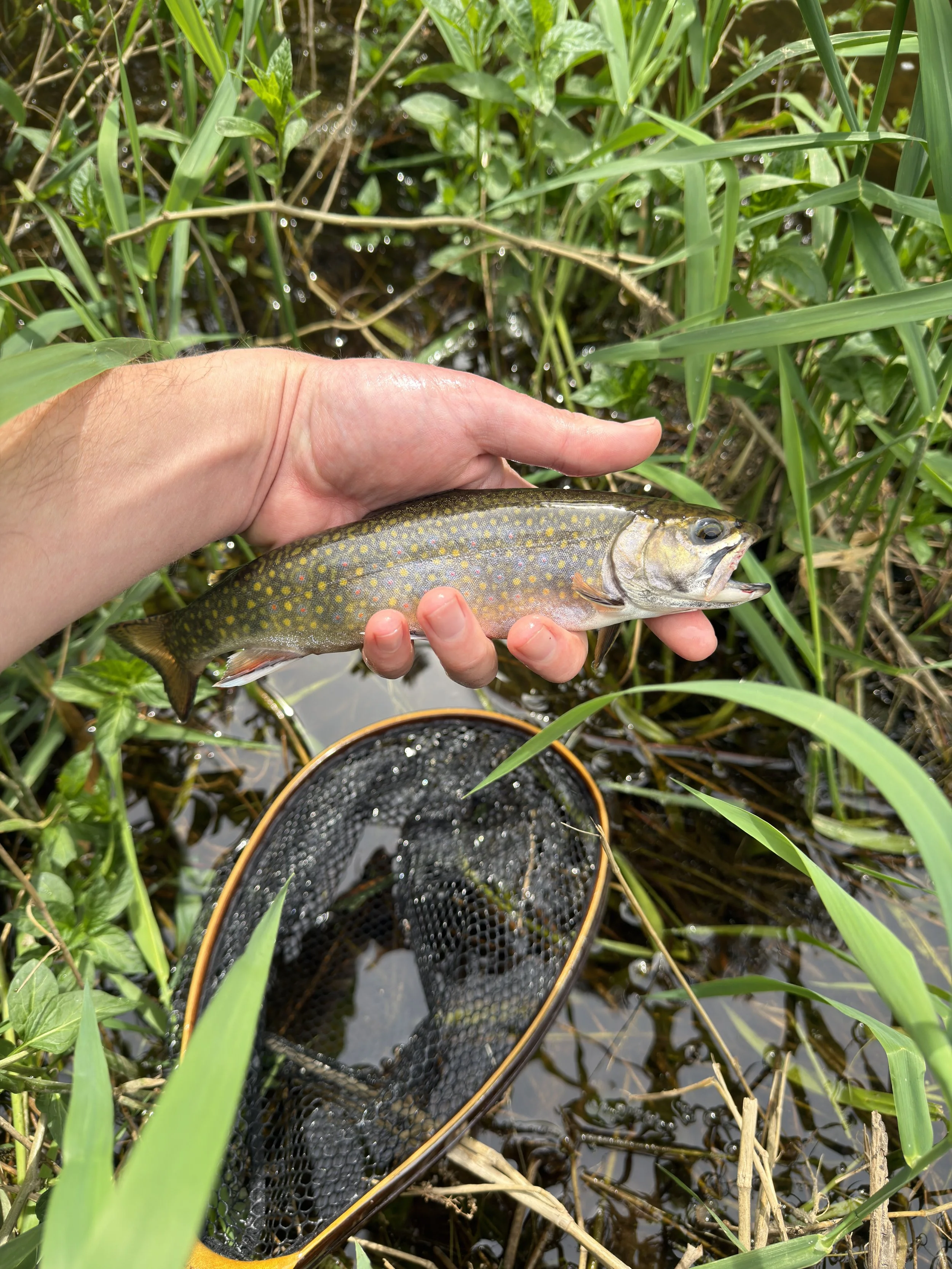
I turned and got on my knees, saw where the fish had been and placed the fly above it in the light current. There was no slurp. There was a slam, a roll, a jump. A good-sized trout fell back to the water and raced downstream. I let it run for a bit and when it made a turn, I held my line against my rod and pulled. The trout re-routed and started to head back upstream my way before jumping one more time, looking to spit out the hook or gain enough slack to dislodge the fly. It hit the water and I pulled back; the bend of my 3wt fiberglass rod a tight horseshoe by now. I drew more and more flyline through the guides of my rod as the fish jetted back my way and pulled tight when he was passing by. Into the net, and a nice 10” brook trout was in my wet hand. I unhooked the fly from its lip, and released it back into the creek before kicking myself that I should have kept that invasive fish for a nice fry lunch back home. But I was a bit shocked. I had never seen a brook trout in this creek, and though I had fished a lot of it over the past three decades of life, I had never fished it this far up. For the next thirty minutes, ten brookies around the size of 8-12” hit my net off the same Adams fly and within the same forty feet of creek. For the first day of catching fish so far in 2026 for me, it was a grand slam.
The brook trout has always interested me, as a fisherman, a lover of nature and all things water, and as a creative. The brook trout, while invasive in this neck of the woods, are dumber than the other trout and, honestly, fight harder than any other trout around here. This could potentially be because they aren't trout at all. No, the brook trout (Salvelinus fontinalis) are a species of char. They do belong to the same family as salmon and trout, being Salmonidae, but they are closer in relation to the great Arctic char than they are the rainbow, the brown, and the cutthroat. Brook trout are in the Salvelinus family, and are native in the eastern side of North America. Looking out at the far side of the creek, they are not unlike the Western redcedar. The redcedar is not a true cedar as it belongs to the cypress family (Cupressaceae) and the genus Thuja. The true cedars belong to the genus Cedrus. In fact, the reason that redcedar is a conjoined word rather than being split up is to signify that it is not a true cedar. However, unlike the brook trout, the redcedar is native to our lands up here.
The brook trout population was introduced in the late 19th and 20th century as a way to expand sport fishing as they were known by the settlers that came from that neck of the woods as beautifully colorful, aggressive eaters that put on a fight when the line became taut. However, they flourished in our waters and started to out-compete our native fish in ways that sort of correlate with how such settlers treated the natives of this fine land that we now have decided to call ours.
I am all for the eradication of the brook trout, but that does not mean that I don’t like having the ability to go out and target the species. For one, they are the one trout-esque fish up here that I will keep from our creeks and eat. Not only do I feel like I am helping on the conservation side of things by removing some of the bigger ones from the creeks that hold our darlin’ Westslope cutthroat trout, but they are, in my opinion, some of the best tasting fish in our region. However, my favorite part about the brook trout is its look. Dark olive-greens and browns designed individually with the wavy worm-like vermiculations, what I like to call the brooks on the brook trout, on the ridge of its back create a piece of artwork on each fish along with the blue halo’d red spots and its yellow spots, a red belly and white edged lower fins make each and every brook trout unique and almost surreal to see compared to others in our area. There is something alien about them, and it makes me more and more excited when I have the opportunity to cast a fly to one.
After a good while of admiring, I knew that the sad time had come where I had to take my rod down, load up the car and head home. If it wasn’t for the newborn at home, I may have been able to squeak out another hour or so. But I had my own unique little girl to see at home, and help my wife out with and I couldn’t wait to get back home to see them. And the boy of course.
Tight lines out there, friends.