I opened the first column I ever wrote for Casting Conversations with the clincher line “I was off to my least favorite fly-fishing river in the northwest: the Kootenai”. Of course, I wrote this to be a bit of a provocateur–something I very much like to be to spark up larger conversations–but also, I did believe it. I go further into detail with the claim, saying that I am mainly talking about wade fishing and understand that if you have a boat of some kind, the fly fishing is world class. I have had some time to think, some time to process my thoughts about the river, and I would like to consider this week’s column as a refutation.
I have fished the Kootenai River since I was a little tyke, and the number of years has exceeded three decades in a healthy manner by this point. From worms and bobber, rooster tail, jigging, and crawdad trapping, I have seen all the species in the Kootenai River except for a sturgeon at this point. When I picked up fly fishing two decades ago, of course I set out to catch the trout of the Koot on my new found obsession as well. After getting skunked multiple outings, I grew a hatred in my heart for fishing the river from the shore with my big waggly stick. A trip in a canoe or two gave me hope, but wade fishing was just something I couldn’t get right on this river at that time.
Well, it’s a good thing that humans, and anglers, grow as they age. I got a bit wiser in how to fish the waters. The first step was learned through reading John Gierach’s last book, All the Time in the World, where he visited the Kootenai River (on the Montana side). He was having issues even getting a trout to look at his flies and he nearly exhausted all his options on the waters. But then he got the idea to tie on an old wet fly of his and started swinging it across and down river. Then the fish began biting, and soon he had landed multiple decent trout and lost a few more. The same day that I read this chapter, I went down to the triangle by my house and started swinging an untreated Hudson Caddis through the current and ended up catching five decent rainbow trout in the span of a half hour. I felt like I had unlocked a cheat code whereas in reality, there is truth held in a Ralph Waldo Emerson quote: “[t]he best tunes are played on the oldest fiddles”.
As the year went on, I found this technique to be less and less effective as the water levels lowered and the trout started rising more. Now, my past experience trying to catch these rising trout on a dry fly had been filled with empty nets and disappointment. Frustration even. Sometimes there is nothing worse than a seam full of jumping fish and no matter what you throw, you never get a look. The arrogance of trying to match the hatch, since it is something you learn early on in the game of fly fishing, can be a stickler into your day of fun and fishing. As I get older, I have realized that matching the hatch is–dare I say it–overrated. Trout are not all that smart. Picky? Sure. Spooky? Yes. But big-brained? Honestly, not that much.
(Sidenote: of course, there are numerous rivers out there where the trout are so picky, so overfished to the point where they have their bifocals tuned in to instantly determine if a fly is close enough to the real thing to take a bite at. But I am talking about the less overfished, less pressured waters here.)
It’s early fall, and generally what will be coming down through the waters between and during other hatches? Well, I got an answer for you. Step out into your unkempt lawn right now and walk around. If you don’t see an abundance of grasshoppers suddenly shoot up, I don’t know what is wrong with your yard. But yes, grasshoppers. Big foam hoppers work well in these waters come August, September, and October. Don’t even worry about trying to match hatches. You may find some luck, but boy, just throw on a fat hopper pattern and the trout cannot resist them. Dave’s Hopper, Chubby Chernobyl, Parachute Hopper patterns, large fat foamy boys. Big, fat butted ant patterns work just as well too. They are all successful this time of year since they are abundant, and abundantly falling off the banks of the Kootenai continuously.
Something else coincides with this advice as well, and it is a new found love for the river. But this love is seasonal. When the waters are high through spring and summer, I still hold a disdain for the river. The water is high, the current flushing, the mud and silt bottom deep, and the fish would rather eat something under the surface rather than floating on top. Blech. But come autumn, the leaves begin to change, the water lowers, and much of the bank starts to become a bit more wadeable. However, the water is a bit cold and I still need to wade up to my nether region to get into most of the good fishing. And here comes my most recent breakthrough in terms of fly fishing the Kootenai river (and yes, it is obvious. But throw me a bone).
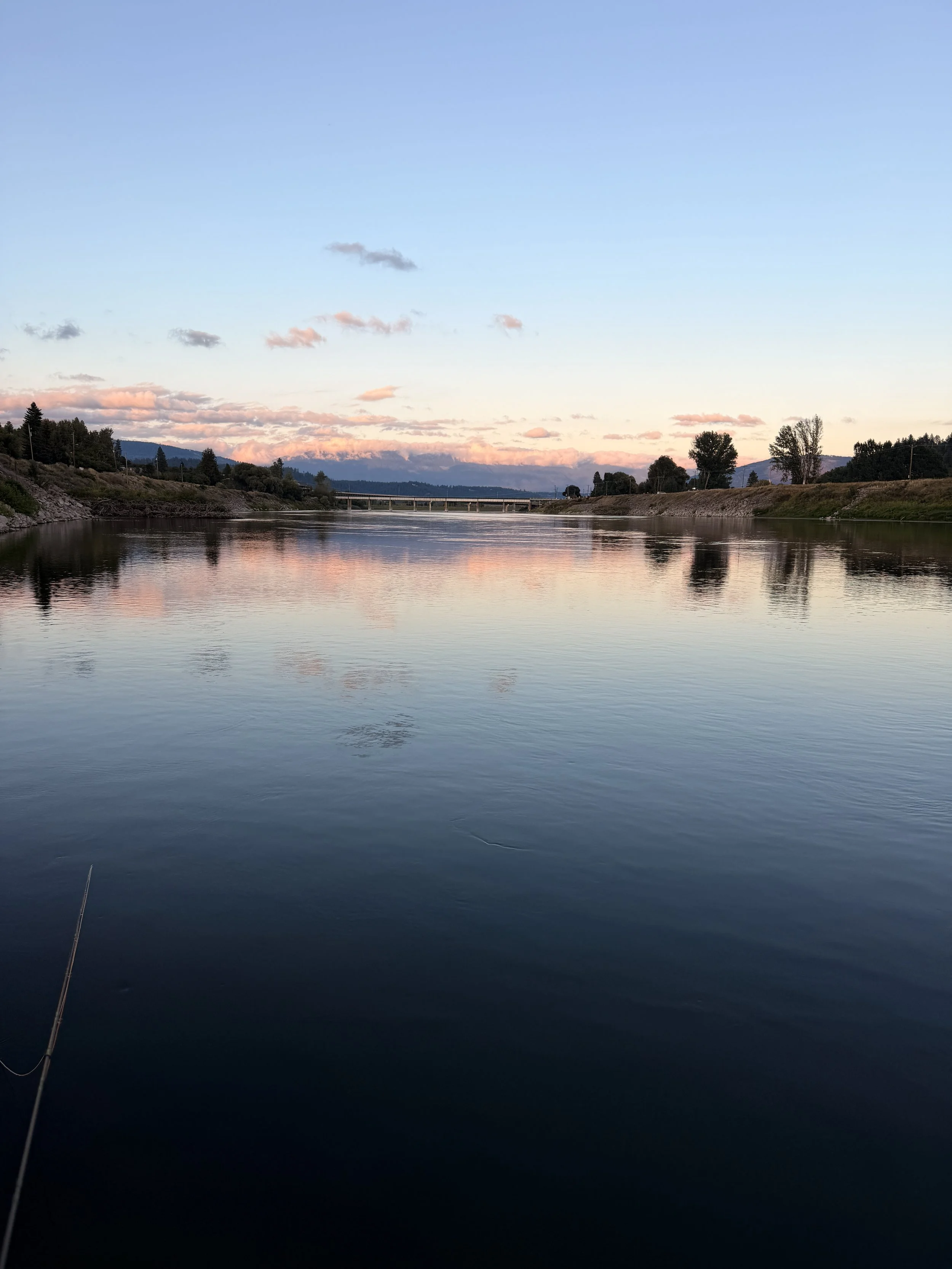
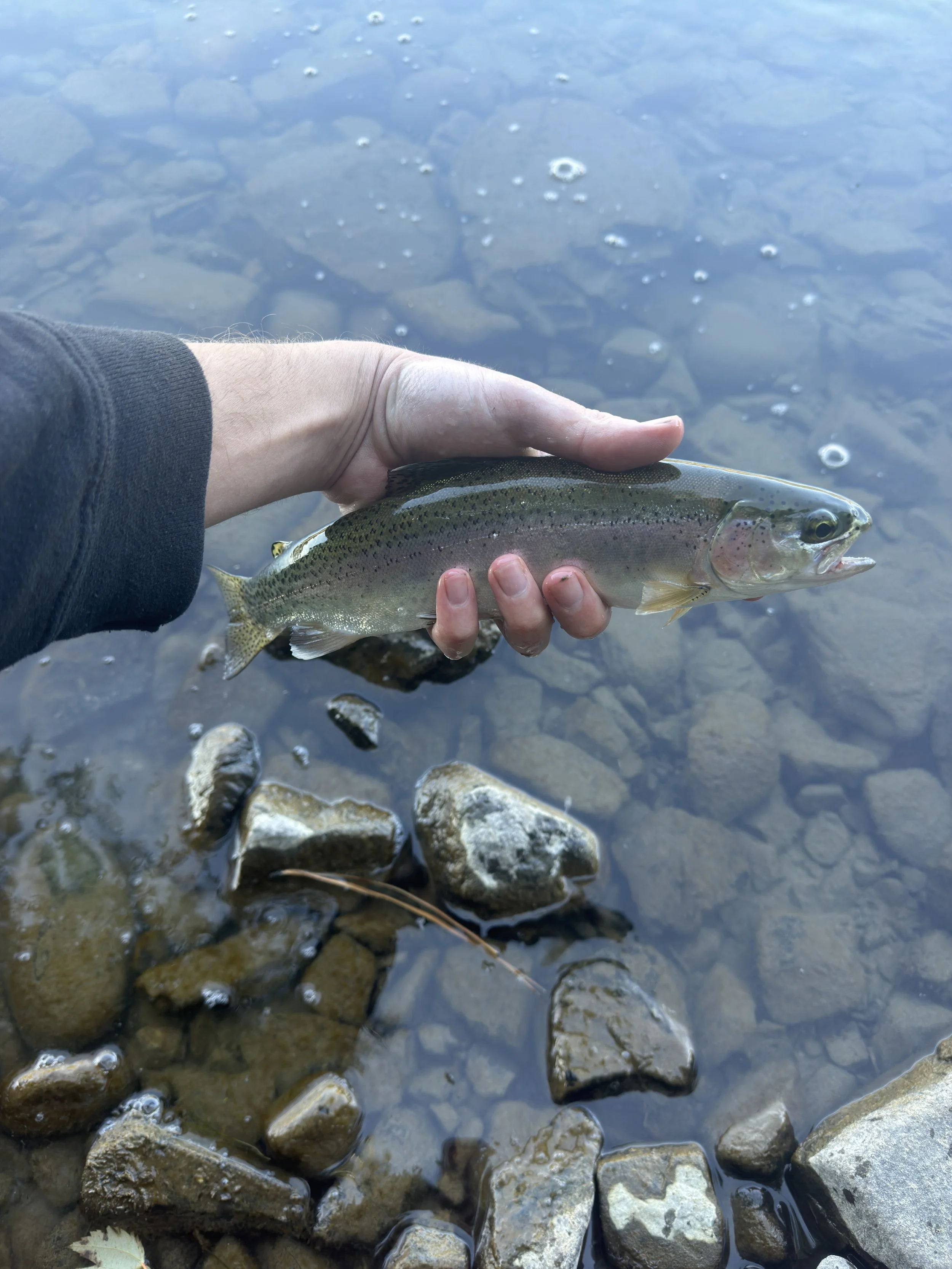
I work at a bookstore and write an unpaid column for a local newspaper. Buying a pair of waders has been out of my budget before I was even out of my mother’s womb. But luck and a kind heart have a way of making things happen sometimes. Leeanna Young of The Last Resort here in town decided to retire from guiding on the Kootenai this year, and since we have gotten to know each other a bit, she decided to slip me a few gifts. In said gifts were a pair of old Simms waders and a pair of large wading boots. With this lovely gift (thank you, Leeanna), so many more options have opened up for me. The day after I received them, I tossed them on and went down under the 95 bridge in downtown Bonners Ferry (this is not blowing up any spots to all you who might have started seething over this; you can see the fish jump–and the fisherman fish–from the bridge. So, please hold back your tears). I had forty five minutes to fish before I had to pick up my son from his last day of pre-school, and twelve trout came into my net before I hauled my way back up the hill to my car. I was waist deep in strong, everchanging currents about fifty yards from the shoreline and I would have never been out this far without these new-to-me waders. I also would have never been out here until the river lowered as much as it did.
A few days later, my father-in-law sent me a text to see if I wanted to go fishing on a Sunday and, after I agreed to go with my wife and children to church in the late morning so I could help wrangle those crazy kids during the sermon for her, I told him that I could head out in the morning. We were heading out to a spot known to many locals, unknown to anyone new to or from out of town, and while I have always hated shorefishing the river in this spot, I had a new set of gear that was bound to help me out greatly.
And boy, did it. We arrived at around 7:30 in the morning, and it was time for my sermon; a communion with my small gods in my church of rushing waters. I fished up the river while he fished down. After a slow start, I landed my first trout on a purple bellied large ant pattern I had. In the net, unhooked, and out of the net. After thanking the fish, I was distracted by a large fishing jumping upriver in my peripheral vision. I snapped my eyes up and watched the large ripples spread out until they faded back into the waters they came from. Then another jump. It was a large fish.
I slowly made my way through the water so as to not spook the trout, and cast the fly about five feet above where I saw the trout rise. After about four seconds, I set the hook as the fish took the ant and my fiberglass rod bent deep. I followed the fish as it raced downriver and cut back into the stronger current. I had lost so many large fish this year that I was determined to not lose this one. I let it run for a bit, played it back down the river and over towards the calmer waters. It jumped, and I let slack out. After it landed and tried to race back to the current, I held my rod up and started to pull in line again. I pulled my creek net out, realizing that it might not be big enough to contain the fish that I was actively bringing closer and closer. The trout made a few more runs, and then it was bent into a U-shape in my net. I felt its weight. I saw the large, deep orange slashes under its head. I pulled out my 16” piece of old fly line I use to measure the trout of the river for a legal keeper and it exceeded those regulations. It was the biggest westslope cutthroat I had ever caught on a fly rod measuring to about 17” (sadly, not picture). Not large, but big enough. A sheer beauty; a god to worship. A beautiful, native trout from the immaculate autumn run of the Kootenai river. I am sorry that I ever doubted you.
And best of all, I outfished my father-in-law.
Tight lines out there, friends.