
I’ve written about writer's block, or the idea of it, once before for this column; really, just a few weeks ago. One might see this as weakness. I am rehashing ideas, I am starving, I am stuck at the typewriter with the proverbial block upon my dome.
But that isn’t what this is about at all. In fact, in that last article I had made a jab about how writer's block isn’t even a real thing considering, well, one can just write about writer's block. One of my favorite assignments I ever received was in a high school English class with Craig Anderson. As we sat around our tables, he placed a single penny in front of every student and asked the class to write a story about it. Someone who’s right brain is not as open as their left would look at this and maybe jot down the minute details of the penny such as the size, coloration, the date, how handsome Lincoln is to them or not. But a few folks wrote about the travels of said penny and how it arrived at their desk. Some people wrote a story that only started with the penny and ended up into a wild goose chase or a survival story or maybe even a horror story. The point I’m trying to arrive at here is that even the most mundane thing can turn into an adventure, a rollick, a jaunt, a story. It all depends on how you look at it.
But then there are times that the right brain takes full control and doesn’t let go. While writing this piece that you are reading now, I became distracted. I realized that spring is here and, since the winter was so odd and unnatural, my completely natural habit of cleaning lines and greasing reels had been completely skipped over since every week there was a chance that there was some trout out there rising to a weird winter hatch. I left for the spare bedroom only to first be stopped by a splotch of blood on the floor in the living room; a little gift that our one year old menstruating yellow lab dripped for us while running towards the back door to be let outside for her morning whizz. I picked up some floor cleaner and a rag and got down on my hands and knees to scrub it up. As I did, I noticed another one in which I crawled over the wood floors to get to and scrubbed again. Then, a large clump of cat hair caught my eye under the recliner, which when pulled out also provided me a terribly tied #18 Adams which I could only date back to some time only categorized by “way back when”. It must have fallen out of my fly box sometime last summer. A few feet away, I spotted another: a #16 Renegade. Lot’s of memories with both those flies; both absolute killers in this neck of the woods. I gathered them up in my hand and continued to scour the floor. A few two-three inch pieces of tippet to send to the trash, some yarn from either a tying project or from my scissor-obsessed son. A misplaced marble; a handful of change.
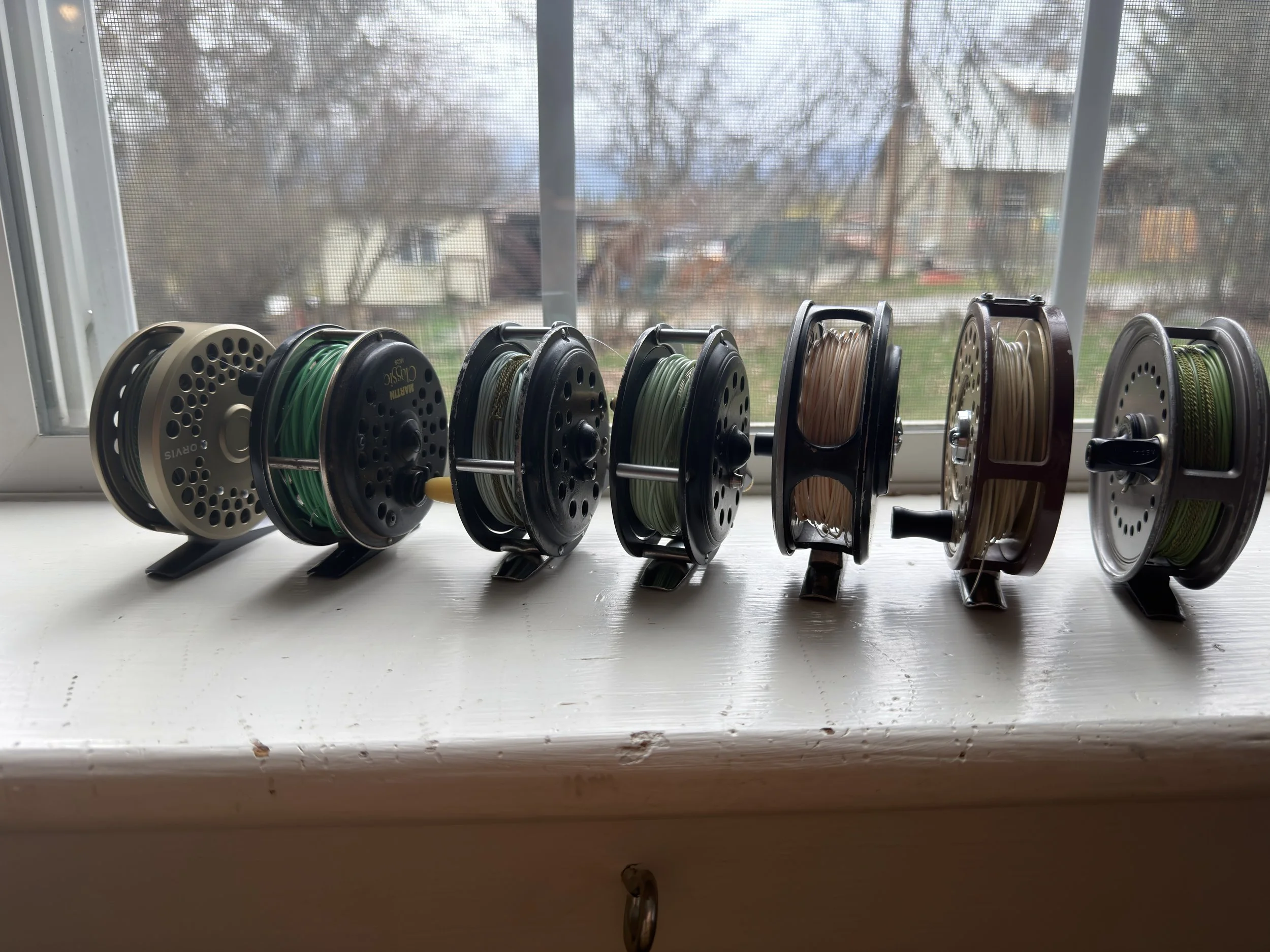
I placed it up on a coffee table and began to kneel down again before remembering that I was doing something before I started the floor expedition. But what was it? Well, I did have to write an article but all I had was a short rant pseudo-rant about writer’s block. That just won’t fly for a fly fishing article, I thought. But what else was I doing? It was the same feeling when you walk through a door to get something but right when you turn the doorknob and cross the threshold of the frame, you forgot the whole reason you went in. I grabbed the flies and took them into the spare bedroom/office/greenhouse/cesspool that my tackle is stored in and grabbed my dry fly box. The shoddy Adams next to my nicer Adams, my Renegade by the rest of them. I put the box back down, and picked up my Orvis Battenkill to spin it a bit and listen to the intoxicating high pitched hum of the old click and pawl. Only because of that did I remember that I was going to clean my fly lines.
Why do we clean fly lines? I do not really know if anyone would actually ask that question. Of course, the obvious answer though is that all things deserve to get clean. Well, except the outside of cars. I will never understand spending the time, or money, to wash a car only for it to get dirty again. Folks, your rig can stay filthy. It’s ok. But a dirty fly line is bad for a many reasons. We clean them to help with flotation as dirt and gunk and mildew can weigh it down in the water where every quarter ounce matters. That same dirt and gunk and mildew can accelerate degradation of a line, causing issues such as cracks, poor memory, tears, and weakening of the fly line. A clean fly line will also allow for easier and more lengthy casts. An unclean fly line has many more ways to get caught on the rod guides and it will provide more texture to interrupt what should be a smooth movement of the line as you cast.
Now, a fly shop will usually have line cleaning products that might catch your eye. But like a lot of products shoved in a fly fisher’s face, they are made to hook the angler with promises that it is better than anything you could ever use. At this time, I will let you in on a few secrets. Line cleaner? Line cleaning towelettes from Rio? Psst, you don’t need it. You got warm water in your house? Do you have some non-detergent based mild soap? Well, by mixing those two things together, you can actually take a rag that you probably have around the house, dip it into that mixture, and use it to clean your fly lines just fine. And it will save you some money. I know, it is pretty insane.
Here is another pro-tip that is not a part of fly line cleaning but that I think most fly fishers should know. We like our dry fly floatant. It is a necessity. Dries will get wet, dries will start to sink. I was a big user and unofficial spokesman for Gink for the longest time. But a bottle of it is about $6 at the shop, and depending on how often you go out and change flies, it can be a bit taxing on the wallet. Loon puts out some good fly floatant, and there is Hi-Flote. But those are also around the same price point. So here is a trick I learned from a lovely lady in town: Albolene. It is a makeup remover and facial cleanser sold at most drug stores, Wal-Marts, and grocery stores. For a 12oz jar of it, the price point is around $10, and it will last you a very long time. As no one wants to carry a large tub of it around in their vest or pack, you can easily scoop some out and put it into a smaller container. Some use old pharmaceutical bottles, some use the little Carmex chapstick tub when it has run out, or you can do as I have in the past and pick up a little plastic balm tub from the dollar store. A 12oz jar of that stuff will literally save you more than $100, the floatant is arguably better, and everyone in the know is using it anyway. Another bonus of the albolene is that it can keep your guides from freezing during winter fishing as well (just be sure to keep it off the rod itself). And to wrap back to fly line cleaning, I have even heard of people using it to clean and maintain their fly lines. Now, I haven’t since I am fine with just some soap and warm water, but it is an option.
Now let us quickly talk about the other reel cleaning that should be done every other year, if not every year: greasing. Why grease a reel? Well, to prevent rust and oxidation, keep the thing operating as it should, and extend the life of the reel by making it easier for the operations of said reel to, well, keep operating as it should. But this is another thing that the fly shops and professionals may try to upsell you on as well. There is Quantum Hot Sauce, Loon Reel Lube, Lucas Fishing Reel Oil, et cetera. But these small tubs, like the fly floatant, will start to add up in cost over the years. It is not as taxing as you won’t be using them daily, monthly, or sometimes even yearly (though you should). But let me tell you that one single dab of Lucas Red “N” Tacky is all you need, and a tube of that will last you a lifetime. It will probably even be something you can pass down to the children in the future.
Cleaning a fly reel is an easy process. First, take the reel apart. Clean the spool and the frame with warm, soapy water (heck, use the same mixture that you clean your fly line with). Dry the reel thoroughly and then place a small little dab of grease on the spindle, the gears, the pawls, preferably using a toothpick or a cotton swab to spread it gently into all the moving parts. Make sure not to overgrease, put your reel back together and give it a few spins. Viola.
Clean up your fly rods a bit, let them dry, place them back in their sock and slip that into the case. Now you are ready for the late spring fishing in the creeks, rivers, and lakes. And it didn’t take you all that long, unless you first spent a half hour crawling around your living room like a madman finding treasures among the dust bunnies.
Tight lines out there, friends.